
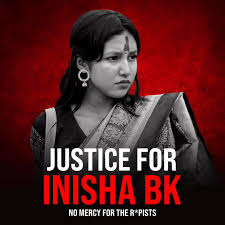
The alleged rape and murder of 16-year-old Inisha BK has shaken Nepal and sparked widespread outrage across the country. Citizens, activists, political leaders, and youth groups have taken to social media and public spaces demanding justice under the banner #JusticeForInisha. The tragedy has not only exposed the brutality of the crime itself but has also ignited a larger national debate about women’s safety, systemic inequality, and the failures of institutions meant to protect vulnerable communities.
A Nation reacts with anger and grief
The case quickly went viral on social media platforms as people expressed anger and sorrow over the incident. Many users questioned why such crimes continue to occur despite laws meant to protect women and children.
One user, Aziz Malik, wrote on X (formerly Twitter):
“How many more daughters and sisters have to die before our laws actually take actions? These monsters don’t hesitate because they don’t fear the consequences. No more excuses, no more ‘mercy’ for the merciless. We demand real justice for Inisha BK. #Inisha #NepalGovernment.”
Similarly, the youth organization Gen-Z Front Nepal condemned the incident and urged authorities to act decisively.
According to their statement, the government and police administration must treat the case with the utmost seriousness and ensure that those responsible receive the strongest possible punishment under the law. The group also warned that any attempts to shield the culprits would not be tolerated.
Social inequality and the Dalit question
The incident has also highlighted deeper social issues in Nepal, particularly those related to caste discrimination and violence against marginalized communities. Inisha BK belonged to the Dalit community, a group historically subjected to social exclusion and discrimination.
A social media user named Yatish cited alarming statistics in his response to the incident. According to his post, children between the ages of 11 and 16 have been among the most affected by sexual violence in Nepal over the past five years. He further noted that approximately 21 percent of rape victims in Nepal are Dalit women, and in many cases such crimes end in murder.
These figures have intensified calls for accountability and systemic reform. Many people are asking difficult but necessary questions:
- Why do such crimes continue despite legal frameworks meant to prevent them?
- What role should educational institutions play in shaping attitudes toward gender equality?
- Why has infrastructure development not been matched by progress in social awareness and safety?
Yatish summarized these concerns by asking where the state and society have failed, emphasizing the need for a comprehensive assessment and transformation of institutions responsible for justice and public safety.
Political response
Political leaders have also spoken out following the tragedy.
Pushpa Kamal Dahal, the coordinator of the Nepali Communist Party and former Prime Minister of Nepal, expressed sorrow over the incident and demanded a fair investigation.
In a Facebook statement, he said he was deeply saddened by the criminal act and extended condolences to the victim’s family. He further called on the government and relevant authorities to conduct a prompt, transparent, and effective investigation and to take strict legal action against those responsible.
Such statements reflect growing pressure on authorities to ensure that justice is delivered swiftly and transparently.
Public protest and civic mobilization
Public anger soon moved beyond social media. Demonstrations were organized demanding justice for the victim and accountability from the authorities.
One of the key protests took place at
Maitighar Mandala, a symbolic location often used for civic demonstrations in Nepal.
Several organizations participated in the protest, including:
- The Caste System Elimination Front
- The Scientific Socialist Organisation
- Youth groups from Gurbhakot
- Various civil society activists and concerned citizens
Protesters demanded an independent and transparent investigation and emphasized that justice must be served without political influence or interference.
Police investigation and arrests
Authorities have begun investigating the case. A team from the
Central Investigation Bureau (CIB) was deployed to assist local police in the investigation.
According to CIB spokesperson Shiva Kumar Shrestha, an expert team was dispatched from Kathmandu to support the investigation in
Surkhet.
Local police from the District Police Office in Surkhet also formed a separate investigative team. Karnali Police spokesperson Ram Prakash Shah confirmed that cooperation with the CIB was requested to ensure a thorough and professional investigation.
Initial reports indicate that four individuals have been arrested based on preliminary findings. Authorities also confirmed that the suspects are believed to be minors according to school records, though verification of their citizenship status is still ongoing.
Police investigators are examining the suspects’ mobile phone and text message records to determine whether they had any prior connection with the victim.
Incident
Sixteen-year-old Inisha BK was originally from Gurbhakot Municipality-6 but had been living with her mother in Birendranagar. She was a Grade XI student.
Initial reports stated that she left home early in the morning on March 7 for what was believed to be a walk with friends in the Janajagaran Community Forest area. However, according to her mother, she had actually gone out to attend tuition classes.
Authorities believe that during her journey she encountered four teenage boys in the forest area where the assault allegedly occurred.
Her friends later found her unconscious and reported the incident to the police. She was rushed to the provincial hospital but was declared dead upon arrival by doctors.
Following a complaint filed at the police station, authorities initiated a criminal investigation and placed the suspects in police custody. Their remand has been extended by the district court as investigators continue gathering evidence.
A wider reflection on society
The tragedy of Inisha BK has become more than a single criminal case; it has evolved into a national reflection on the safety of women, children, and marginalized communities.
Many citizens now question whether justice systems respond adequately without public pressure. The growing perception that perpetrators can escape punishment unless citizens demand accountability has eroded trust in institutions.
For many activists, the central issue is not only punishment but prevention. Addressing gender-based violence requires stronger law enforcement, social awareness, educational reform, and systemic protection for vulnerable communities.
The demand for Justice
The message from the public is clear: justice must not only be done but must be seen to be done. Citizens across Nepal continue to call for transparency, accountability, and swift legal action.
The tragedy has sparked a powerful national conversation about safety, justice, and equality. For many people, the hope is that Inisha BK’s case will not become another forgotten headline but a turning point that compels institutions and society to act.
The demand remains strong across the country:
Justice for Inisha BK.